Monday, April 1, 2013
Where Have You Gone Joe DiMaggio?
Some say Pete quit and is livin' in Nepal, fighting for religious freedom. . .
Some say Pete is serving time after getting nabbed with a half pound of coke and two underage midgets at a Motel 6 outsida Bakersfield. . .
Some say Pete got smacked with a foul tip (foul ball!) and now wanders these United States one step ahead of the terrible green monster within him. . .
The truth is that I moved to Tennessee, met the worst assigner ever, got suspended for a righteous ejection, and quit umpiring. Last season was a dream for me as an umpire. I exceeded all of my goals, including a prestigious college World Series assignment (no, not D1, silly!). I was a member of a great college umpire group, all of my assigners were amazing, and we lived all in peace and umpire excellence - just read the blog!
Last June I moved to Tennessee and started umpiring from the bottom (as is proper and customary). Unfortunately, I nearly immediately tossed the organizer/ rat coach of a summer league and lost my games. The assigner has no backbone. More unfortunately for poor Pete, he is a bigwig in the area, especially for college ball, so I had to decide my course of action. I decided to walk away. I did not go to any camps or clinics, I did not attend the NCAA meeting, I did not register for high school, I quit blogging. . .
Know what? The world didn't end.
I spent more time with my family. I went on vacation. As I write this I am at the pool instead of a ball field. I am also a new volunteer head coach for my 9 year old daughter's softball team. I intend to blog for her team and about my experiences.
I will keep Midwest Ump online, but the comments are disabled. My experience umpiring was a blast, and I met some really outstanding people in the Midwest and online, notably
Warren from Umpire-Empire
Jim from Ump Attire
Brett from St. Louis
Don from Peoria
Mark from Springfield, IL
Bud and Jason from Springfield, Mo
Keith, Don, Justin, Ramon, Kerry, Johnny from central Mo
Bud and Pete, from IL
Ken from St. Louis
The love and generosity these men give to their fellow umpires and to the sport is amazing! If you find brothers like these, "grapple them to thy soul with hoops of steel." Turns out, not all umpires are brothers. I bid you adieu and
Don't suck!
Pete


Monday, June 4, 2012
Separated at Birth: Umpire Edition
It seems to me that the umpire head shots from the MLB website and are about as good as photos taken at the DMV. Soooo. . . remember those cheesy "separated at birth" celebrity photos? Well, here is the Midwest Ump version for MLB umpires. Enjoy!


Tim McClelland
Actor James Cromwell
Brian Runge
TV Celeb Kody Brown

Tim Tschida
Children's icon Captain Kangaroo

CB Bucknor
Talk show host Montel Williams

Jeff Nelson
Private Pyle from Full Metal Jacket
Thursday, May 31, 2012
Douche of the Day: Attention Seeking Umpires
Youth baseball teaches many lessons like teamwork, sacrifice, fair play, and giving your best effort. The nature of baseball is mostly about failure and coping with disappointment, especially at the youth level. Even the best players will often fail more than they succeed, whether pitching, hitting or fielding. For the most part, parents, coaches and teammates forgive failure and encourage the child to try again.
"That's ok, Johnny! You'll get 'em next time!"
Baseball is a team sport that allows for individual achievement. What a great life lesson! Each player gets his turn at bat and a chance to perform in the spotlight. For a child, that time can be stressful. With everyone watching the pressure to succeed can be intense for a kid. To ridicule or embarrass a child for failing to hit a baseball, what Ted Williams once called "the hardest thing to do in sports," is not only mean, it is the act of a bully. Yet this is exactly what is happening on many youth fields.
Lately there has been a rash of umpire videos in internet news showcasing youth league umpires with over-the-top strike three mechanics. Here is an example at a 10U baseball game:
The commentary in these news articles is generally something like, "entertaining, but is this appropriate for youth baseball?" Let me answer that:
No
Exaggerated strike three calls are a part of adult baseball. Who doesn't like MLB umpire Tom Hallion and his uppercut strike three call? It's great entertainment. However, umpire theatrics have no place in youth baseball. Unfortunately, many amateur umpire scour YouTube looking for unique punch out calls that will add a little flair to their games. YouTube is full of amateur and untrained clowns flailing around. The danger is that the inexperienced umpire gets the idea that an exaggerated call is the norm. It's not. Even at the big league level mechanics like Hallion's are rare.
There is nothing wrong with being unique, but when it crosses the line into embarrassing a child, it has gone too far. Remember, even umpires are a role model at the youth level, so what does a zany strike three call teach? Nothing good.
No
Exaggerated strike three calls are a part of adult baseball. Who doesn't like MLB umpire Tom Hallion and his uppercut strike three call? It's great entertainment. However, umpire theatrics have no place in youth baseball. Unfortunately, many amateur umpire scour YouTube looking for unique punch out calls that will add a little flair to their games. YouTube is full of amateur and untrained clowns flailing around. The danger is that the inexperienced umpire gets the idea that an exaggerated call is the norm. It's not. Even at the big league level mechanics like Hallion's are rare.
There is nothing wrong with being unique, but when it crosses the line into embarrassing a child, it has gone too far. Remember, even umpires are a role model at the youth level, so what does a zany strike three call teach? Nothing good.
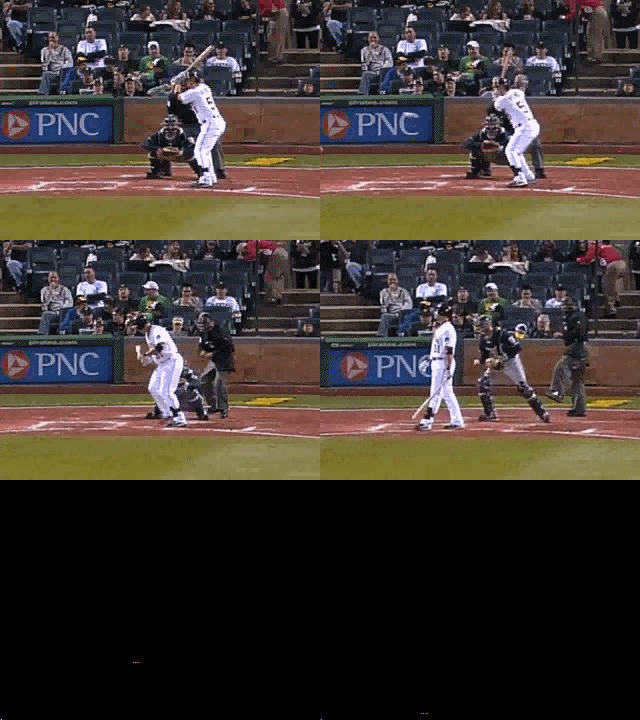
Don't be an attention whore and a douche umpire. Develop a professional and crisp strike three mechanic and leave the clowning to other idiots.
 |
| MLB Umpire Adrian Johnson |
Friday, May 25, 2012
Memorial Day
Memorial Day evolved from Decoration Day, a time when the
graves of fallen soldiers were decorated following the Civil War. Today, Memorial
Day is a national day of remembrance to honor Americans who died serving in the
armed forces.
So what does Memorial Day have to do with umpiring?
Well, this weekend many of us will officiate the Grand Old Game of Baseball – our National Pastime. During this weekend, maybe
between games while sitting in the shade, take a moment to reflect on the tremendous
freedoms we enjoy as Americans, and remember our servicemen who gave the
greatest sacrifice to preserve our way of life.
In many ways baseball epitomizes the American way of life. Baseball
is at once collective and individualistic, much like our democratic society. Baseball
also does not care if you are handsome, are born into the right social class,
or endowed with extreme physical attributes. For instance, the Yankees’ Phil
Rizzuto, usually listed at 5’6”, won the AL MVP Award in 1950. Rizzuto spent three years with the Navy during World War II, and was in charge of a 20mm gun crew on a ship in the Pacific. He is also the only MVP to lead the league in sacrifice bunts.
 |
| Union soldiers playing baseball in 1862 |
 |
| American troops playing baseball in Afghanistan in 2011 |
Our Game is important to our national identity, and has been
played by our soldiers from the Civil War through today. American soldiers would ask, "Who won the World Series?" to flush out German spies. Perhaps the best way to remember our fallen heroes is to participate in our National Pastime and enjoy the freedoms they won for all of us through their great sacrifices. HAPPY MEMORIAL DAY!
Thursday, May 24, 2012
Hero of the Day: Umpire Marty York

One definition of a hero is a person who steps up to the plate during a critical moment. Marty York should know all about that, he's a baseball umpire in middle Tennessee. He steps to the plate during critical moments all the time. But what makes Marty today's Hero of the Day is what happened just outside the diamond, at a youth field parking lot. At this critical moment it was life or death.
On April 26, eight year old Maddox Greathouse was playing baseball at a Franklin, TN sports complex. Maddox's mother was at another field watching another son play. Suddenly, a tornadic storm blew in bringing torrential rains and high winds. The storm sent children and parents running for their cars. Maddox was searching for his mother in the rain when longtime youth umpire Marty York scooped up the youngster just
before a nearby car flipped over at the spot where the boy had been
standing.
Marty was recognized at a special ceremony at the Franklin complex, and Maddox gave Marty a plaque for his heroic actions before hundreds of cheering parents.You know what Marty said about his heroic deed? "He was a brave kid that I just scooped up out of the rain and God did the rest."
GREAT JOB, MARTY! You deserve all the praise for your heroic act!
Wednesday, May 23, 2012
Rules Every Umpire Should Know: Backswing Interference
Baseball is beautifully complex. I know it sounds like a cliché,
but I really do learn something every time I work a game. Heck, every time I
watch a game I learn something. I believe that if you don’t, you just aren’t
trying.
Case in point: earlier this year I worked a high school game
for a small rural school. With the runner on first stealing, the batter swung
through the pitch and hit the catcher with his backswing. What is the correct
rule?

Backswing Interference in Professional Baseball and College
Baseball
When a batter swings through a pitch and makes contact with
the catcher (his mitt or his person) during his backswing, the ball is delayed
dead. If the catcher throws and the throw directly retires the runner, the
interference is disregarded. Otherwise, the ball is dead and runners return to
TOP bases. [OBR Rule 6.06(c) CMT]; [NCAA Rule 6-2d-2]
If the batter swings, the ball is not caught, and the backswing
hits the catcher, the ball is dead and the batter is out. [PBUC]; [NCAA Rule 6-2d-1).
In this video example, R1 is stealing. The batter hits the catcher
with his backswing and the catcher does not throw. This is backswing
interference and R1 is returned to 1B.
In this video example, R1 is stealing. The batter strikes
out and his backswing hits the catcher. The catcher’s throw does not retire R1,
so the batter is out and R1 must return to 1B.
In this video example, R1 is stealing. The batter hits the catcher
with his backswing and the catcher’s throw does not retire R1. Since the
initial throw did not retire R1, he must return to 1B even though R1 is out on
subsequent play.
Backswing Interference in High School
Inexplicably, the National Federation of High Schools rule
on backswing interference is an immediate dead ball, the batter is out for interference,
and all runners must return to TOP bases.
I kicked the call by enforcing the pro rule at a high school
game. Of course, no one in the ball park (including my partner) knew I had made
the mistake. Heck, I spoke with a state rules interpreter later in the year that didn't know the high school rule off the top of his head (he is also a college official). But that's our job, right? This is one of those plays that occur from time to time, and you
need to be aware of the rules differences at the various levels.
Thursday, May 17, 2012
Douche of the Day! Daryl Keeton

[I started the "Douche of the Day! award yesterday and now see the error of my ways. . . the award is a full time job! -ed.]
Daryl Keeton, age 55 of Jefferson County, Ala., is facing felony charges after he assaulted a 20 year old umpire following his granddaughter's softball game. According to Yahoo! Sports, Keeton spent the game heckling the umpire, then followed the official to the parking lot outside the ballpark where he punched him in the
face and bloodied his nose.
"A bloody nose most of the time will get you a misdemeanor, and that's wrong, but yeah, there's a law on the books that if you assault an official it's a Class C felony. That's a serious crime, and it should be," Chief Deputy Randy Christian of the Jefferson County Sheriff's Dept., told Jonathan Hardison of Fox 6 WBRC.
Keeton, who could face up to 10 years in prison for assaulting an Alabama sports official.
"A bloody nose most of the time will get you a misdemeanor, and that's wrong, but yeah, there's a law on the books that if you assault an official it's a Class C felony. That's a serious crime, and it should be," Chief Deputy Randy Christian of the Jefferson County Sheriff's Dept., told Jonathan Hardison of Fox 6 WBRC.
Keeton, who could face up to 10 years in prison for assaulting an Alabama sports official.
Way to go, Daryl! You are the Midwest Ump Douche of the Day!
Subscribe to:
Posts (Atom)